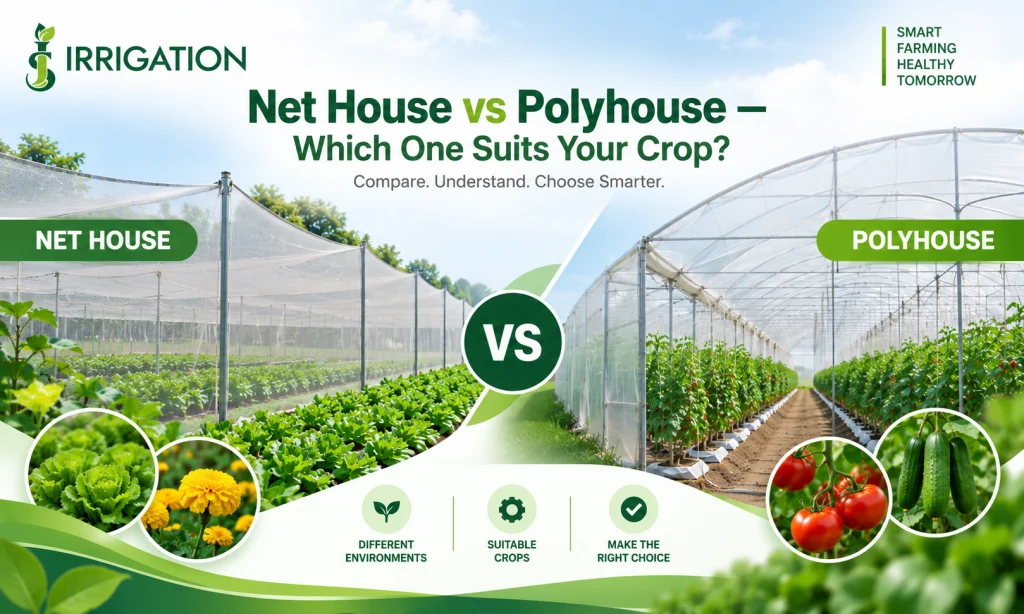
Farmers exploring protected cultivation almost always ask the same question early on: net house or polyhouse — which one is right for my crop and budget? Both structures protect crops, but they solve different problems, so the right choice depends on what you’re growing and where.
What Is A Net House?
A net house uses a shade or insect-net covering instead of a solid film. It moderates sunlight intensity, reduces heat stress and keeps out larger pests and birds, while still allowing natural airflow and rainfall through. Net houses are generally lower-cost to build and maintain than a fully-enclosed polyhouse.
What Is A Polyhouse?
A polyhouse (or greenhouse) uses a UV-stabilized polyethylene film that fully seals the structure, giving you much tighter control over temperature, humidity and pest entry. This makes it the better choice for high-value crops, off-season cultivation, or regions with extreme weather swings.
Cost Comparison
Net houses typically cost less per square meter than polyhouses, since the netting material and structural requirements are lighter than a fully-covered film structure. If budget is the primary constraint and your crop doesn’t need full climate control, a net house can be the more practical starting point.
Which One Should You Choose?
| Factor | Net House | Polyhouse |
|---|---|---|
| Climate control | Partial (shade, wind, some pests) | Full (temperature, humidity, pests) |
| Best for | Nurseries, flowers, shade-loving crops | Vegetables, off-season crops, exotic produce |
| Investment | Lower | Higher, better long-term ROI for high-value crops |
| Rainfall/airflow | Passes through | Fully controlled |
Still Not Sure?
At Jai Shri Irrigation, our team does a proper site survey before recommending a structure — matching your crop plan, plot size and local wind/weather conditions to the right build, whether that’s a net house, a polyhouse, or a combination on the same plot. Get in touch for a free consultation.