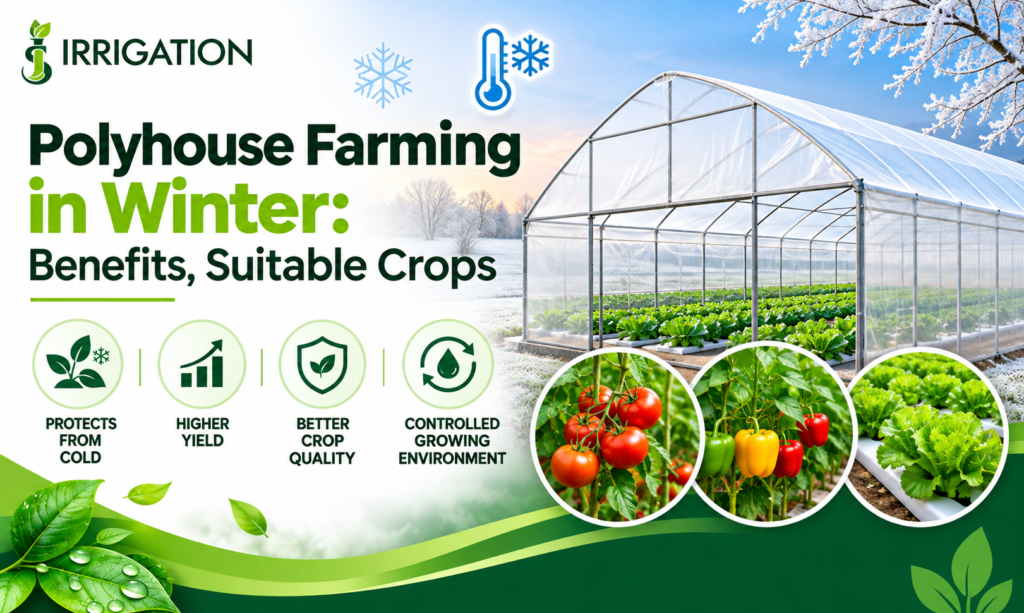
When the cold wave arrives, open-field farming slows down. Tomato, capsicum and cucumber, the crops that fetch good prices, struggle in low temperatures, foggy mornings and the occasional frost (pala). Yet this is exactly the season when markets pay attention to fresh, good-quality vegetables.
As a Protected Cultivation Company in Rajasthan, we are often asked whether a polyhouse really helps in winter, and which crops are worth growing. The short answer is yes, it helps a lot, but only if you choose the right crop and manage the structure properly. This guide covers the real benefits, the crops that suit the season, and the winter mistakes to avoid.
Quick answer: is polyhouse farming good in winter?
- Yes. A polyhouse traps heat from the sun and shields plants from cold wind, fog and frost, so you can grow crops that are very difficult to grow in the open during winter.
- Research from ICAR institutes notes that growing tomato, capsicum and cucurbits in the open field in north Indian winters is extremely difficult, and that protected structures are used to overcome this.
- Naturally ventilated polyhouses are generally suitable for mild winters in the plains of north-western India. During severe cold waves or frost, extra protection may be needed.
- Best choices are crops that respond well to controlled conditions, such as parthenocarpic (seedless) cucumber, tomato, capsicum, leafy greens, herbs and flowers.
- The key risk is low night temperature, because it affects flowering and fruit set in crops like tomato and capsicum.
Why winter is a good time to use a polyhouse
In winter, the open field becomes a difficult place for warm-season vegetables. Nights are cold, days are shorter, fog cuts sunlight and frost can damage tender plants overnight. A polyhouse changes this by creating a more stable space around the plant.
Research on low-cost polyhouses in northern India has found that they help grow vegetables such as tomato, capsicum, cucumber and beans in winter, and that they are also useful for raising vegetable seedlings (nursery) during the cold months. The same research reports that the temperature inside is higher than outside during winter, which is what lets these crops keep growing.
Key benefits of polyhouse farming in winter
- Protection from cold and frost. The film cover reduces direct exposure to cold wind and helps hold warmth gathered during the day.
- Off-season production. You can grow warm-season vegetables when open-field supply is low. Prices depend on your market and timing, so we do not promise any figure, but fresh winter-grown vegetables often meet strong demand.
- Better crop quality. Plants are protected from heavy fog, wind and many outdoor pests, so fruits are generally cleaner and more uniform.
- Healthier seedlings. Many growers raise their vegetable nursery inside a polyhouse in winter, which gives strong, healthy planting material.
- Efficient water use. Combined with drip irrigation and fertigation, a polyhouse lets you give water and nutrients exactly where the crop needs them.
- A longer growing season. Instead of leaving land idle in the coldest months, you can keep it productive.
Best crops for polyhouse farming in winter
| Crop | Why it suits a winter polyhouse | Winter watch-out |
|---|---|---|
| Cucumber (parthenocarpic or seedless types) | Bred for protected cultivation and does not need insect pollination. ICAR has even released a variety tested for winter (November to March) in low-cost polyhouses. | Sensitive to cold; prolonged low temperature slows growth and can cause leaf yellowing. |
| Tomato | A popular polyhouse crop with strong market demand. | Night temperature is the critical factor. Fruit set drops when temperatures are low (university and ICAR sources note poor fruit set below roughly 16°C, and failure to set at around 12°C or below). |
| Capsicum (shimla mirch) | High-value crop that grows well in a naturally ventilated polyhouse in mild winters. | Low night temperature (around 14°C or less) can reduce viable pollen and affect fruit shape and number. |
| Leafy greens and herbs (spinach, coriander, lettuce, fenugreek) | Cool-season crops that grow quickly and are good for small units and regular harvests. | Too much humidity can invite fungal diseases, so ventilate. |
| Flowers (gerbera, carnation, rose) | Winter and the wedding season bring steady demand for cut flowers. | Need the right variety, planting material and a market plan before you start. |
| Vegetable nursery (seedlings) | Protects young plants from cold and gives uniform, healthy seedlings. | Needs careful watering and ventilation. |
Which structure works best in winter?
A naturally ventilated polyhouse is the most common choice in the plains of north-western India. It has low initial investment and, according to ICAR publications, suits cultivation in mild winters. A fan and pad polyhouse is more of a summer solution, where cooling matters most. If your area gets strong cold waves or frost, a double layer cover or extra protection can help, and your supplier should explain these options before you buy.
If you are comparing options for your district, talk to a Polyhouse Company in Rajasthan that can design for your local temperature range, wind and crop, and that will tell you honestly when a simpler structure is enough.
Winter management checklist for polyhouse farmers
- Watch night temperature. Fruit set in tomato and capsicum depends heavily on it. Keep a simple min-max thermometer inside the polyhouse and note readings daily.
- Keep the film clean and intact. Dust, dirt and holes reduce light and let in cold air. Repair tears quickly.
- Open and close vents with the weather. Close side curtains and doors in the evening to hold heat. In the middle of the day, open them to let humid air out, so moisture does not build up.
- Control humidity. Cool nights with high humidity favour fungal diseases and some pests. ICAR notes that fruit borer infestation in capsicum rises when nights are cool and humid.
- Irrigate carefully. Water in the morning rather than late in the day, and avoid overwatering in cold spells, since cold, wet roots grow poorly.
- Plan your planting time. Winter crops in north India are commonly transplanted around October to early November, but the right window depends on your crop and district. Confirm with your KVK or agronomist.
- Scout for pests and diseases weekly. Catch problems early, before they spread in the closed environment.
Common winter mistakes to avoid
- Planting a crop that cannot handle your local night temperatures
- Keeping the polyhouse fully closed all day and letting humidity build up
- Ignoring torn film or leaking doors
- Overwatering because the soil stays damp for longer in cold weather
- Starting without a market plan for the harvest
- Assuming a polyhouse gives 100% protection from severe frost. It reduces the risk but does not remove it.
Before you rely on this guide
Temperature thresholds, sowing windows and crop performance vary by variety, structure and location. The ranges mentioned here come from published ICAR and agricultural university material and are meant as general guidance, not exact rules for your farm. For decisions about variety, planting date and disease control, consult your KVK, State Agriculture University or a qualified agronomist. Subsidy rates and eligibility also change, so check our guide on polyhouse subsidy in Rajasthan and confirm details with the Horticulture Department.
About Jai Shri Irrigation
Jai Shri Irrigation is a manufacturer, trader and service provider of poly houses, net houses, agricultural greenhouses, shade net houses and hydroponic structures, based in Sumerpur, Pali district, Rajasthan. Since 2016, our team of 20 to 45 skilled professionals has delivered over 500 projects for farmers and agri-businesses across Rajasthan, Madhya Pradesh, Maharashtra, Uttar Pradesh, Gujarat, Haryana and other states. We handle site survey, design, fabrication, on-site installation and after-sales support, and most standard projects are completed within 3 to 6 weeks. Our range covers shade net houses, naturally ventilated and fan and pad structures, prefabricated and modular designs, with UV-stabilised films that typically carry a 3 to 5 year warranty depending on the grade, so every Polyhouse for Farming in Rajasthan that we build is planned around your crop, climate and budget.
Frequently asked questions
Is polyhouse farming good in winter?
Yes. A polyhouse protects crops from cold wind, fog and frost and keeps the temperature inside higher than outside, which helps you grow vegetables and flowers that struggle in the open field during winter.
Can a polyhouse protect crops from frost?
It greatly reduces the risk, but it does not give complete protection in severe cold waves. In very cold areas, extra measures such as a double layer cover may be needed. Ask your supplier or KVK for advice on your location.
Which crops are best in a polyhouse in winter?
Common choices are parthenocarpic cucumber, tomato, capsicum, leafy greens, herbs and flowers such as gerbera, carnation and rose. The best crop depends on your district, structure and market.
Can I grow tomato in a polyhouse in winter?
Yes, but night temperature is critical. Published research notes that fruit set is poor when temperatures are low, so choose suitable hybrids, manage temperature and humidity carefully and seek local advice.
Do I need heating in a winter polyhouse?
Naturally ventilated polyhouses are generally used without artificial heating in the mild winters of the plains. In colder spells or regions, additional protection may be needed. Discuss this with your supplier before choosing a design.
Is a polyhouse also useful for raising seedlings in winter?
Yes. Research on low-cost polyhouses in northern India highlights their use for raising vegetable nurseries during the cold months.
Is polyhouse farming in winter profitable?
It can be, but returns depend on crop choice, structure, management, input costs and market prices. We recommend preparing a simple crop plan with expected costs and a confirmed buyer before you invest.